
Kettlebell Training for Beginners in London: A Complete Starter Guide
Everything a London beginner needs to know before picking up their first kettlebell. Movements, weights, frequency, what to expect and what to avoid.
In short
For a beginner in London, kettlebell training 2 to 3 times per week with a 12 to 16 kg kettlebell (men) or 8 to 12 kg (women) is the safest starting point. Master the swing, goblet squat and Turkish get-up before progressing to cleans and snatches.
Kettlebell training is one of the most efficient ways to build strength, burn fat and improve cardiovascular fitness in a single tool. For beginners in London, the barrier to entry is low: one kettlebell, a small space and 30 minutes three times a week will change your body in 12 weeks. The problem is most people pick up the wrong weight, use poor form and either get hurt or see no results. This guide covers everything you need to start correctly.
What is kettlebell training?
A kettlebell is a cast-iron or cast-steel ball with a handle attached. Unlike a dumbbell, the weight sits below the handle, which creates a different centre of gravity and forces your stabilising muscles to work harder. This makes kettlebell training uniquely effective for building functional strength, power and conditioning at the same time.
What weight kettlebell should a beginner start with?
The most common mistake beginners make is choosing a kettlebell that is too light. A kettlebell that you can press easily for 20 reps will not build strength or power. Here are sensible starting weights for someone with no kettlebell experience:
- Men, average fitness: 16 kg for swings, 12 kg for presses
- Men, deconditioned: 12 kg for swings, 8 kg for presses
- Women, average fitness: 12 kg for swings, 8 kg for presses
- Women, deconditioned: 8 kg for swings, 6 kg for presses
These are starting points. As you build competence you will progress. Most people underestimate what they can swing while overestimating what they can press. The swing is a lower-body movement; the press is an upper-body movement. Treat them differently.
The 4 foundational kettlebell movements
There are dozens of kettlebell exercises but only four you need to master as a beginner. Everything else is a variation or combination of these.
1. The kettlebell swing
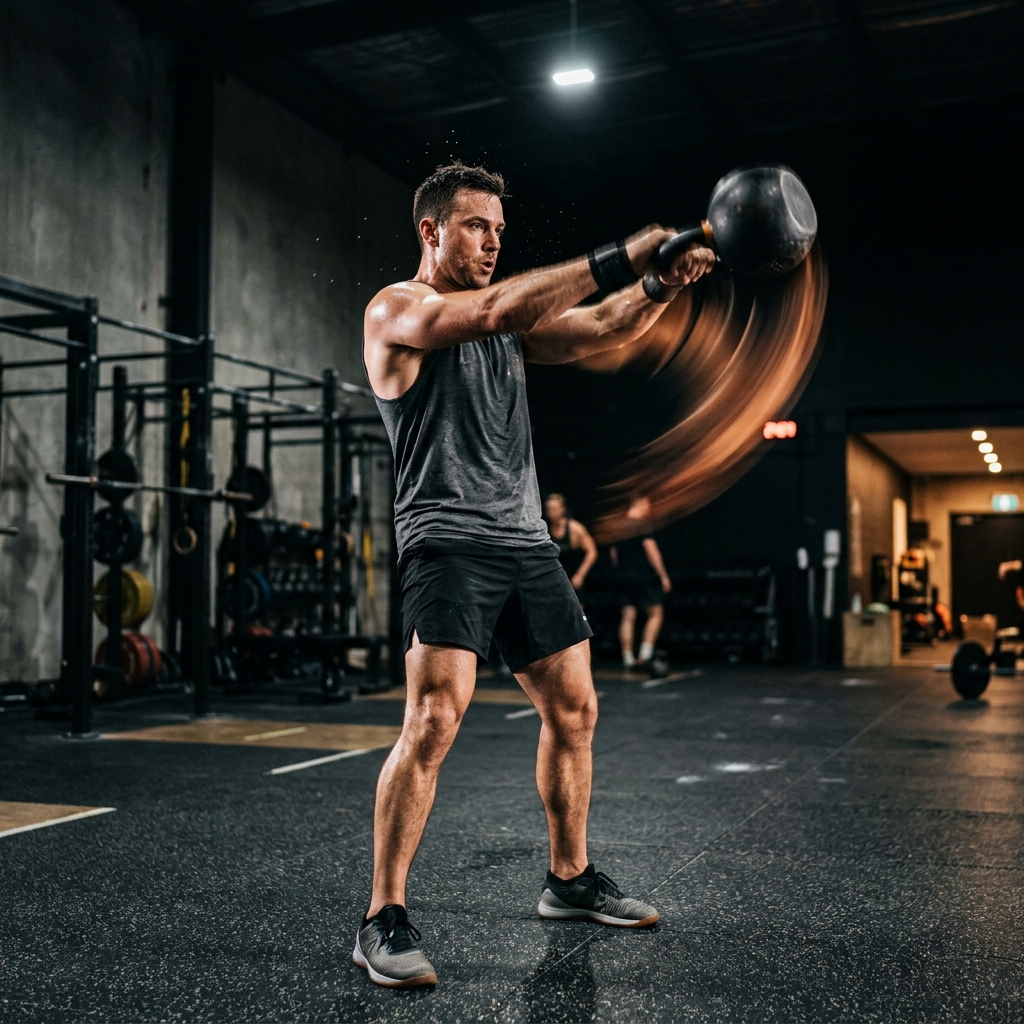
The swing is the cornerstone of kettlebell training. It builds explosive hip power, posterior chain strength and cardiovascular fitness in one movement. The bell is swung between the legs and driven up to chest height by snapping the hips forward. The arms do not lift the bell. The hips do. Done correctly, the swing is one of the safest exercises for your lower back because it reinforces the hip hinge pattern. Done badly, it is a fast track to a back injury. Get coaching on this one before you load it.
2. The goblet squat
Holding the kettlebell by the horns at chest height, you squat down between your hips. The goblet squat is the most accessible squat variation for beginners because the front-loaded weight encourages an upright torso and forces you to squat between your hips rather than folding forward. It builds leg strength, core stability and hip mobility simultaneously.
3. The Turkish get-up
Lying on the floor with the bell pressed overhead, you stand up while keeping the bell locked out above you, then reverse the movement back to the floor. The Turkish get-up is the most underrated exercise in fitness. It builds shoulder stability, core strength, hip mobility and total-body coordination. It is also a powerful diagnostic tool: any weakness or asymmetry in your body shows up immediately.
4. The kettlebell clean and press
The clean brings the bell from the floor to the rack position in one smooth movement. The press takes it overhead. Together they form one of the best full-body strength movements you can do. This is an intermediate movement, but worth working towards because it builds raw strength and athletic power.
How often should a beginner train with kettlebells?
Three sessions per week is the sweet spot for most beginners. Two is enough to progress slowly. Four is too many while you are learning the skills. Each session should last 30 to 45 minutes including warm-up and cool-down. A simple weekly structure:
- Monday: Skill focus on swing and goblet squat, 30 minutes
- Wednesday: Turkish get-up practice and core, 30 minutes
- Friday: Full conditioning circuit, 40 minutes
- Weekend: Walk, stretch, recover
Common mistakes beginners make
- Squatting the swing instead of hinging. The swing is a hip hinge, not a squat with a bell.
- Using the arms to lift the bell. The arms guide. The hips drive.
- Starting too heavy. Ego lifting with kettlebells ends in injury.
- Training through pain. Sharp pain is a stop signal, not a challenge.
- Skipping the warm-up. Cold hips and shoulders are injury magnets.
Coach's note
If you are based in London and want to learn kettlebell training properly, the fastest and safest route is a few sessions with a qualified coach. Bad movement patterns are harder to unlearn than to learn correctly the first time. Book a free 45-minute taster session to see how proper coaching feels.
Where to train with kettlebells in London
Most commercial gyms in London have a small rack of kettlebells tucked in a corner, but few have the space or the coaching culture to use them well. Specialist studios, private PT spaces and outdoor parks are usually better options. If you want to train at home, a single 16 kg kettlebell and a 2 metre by 2 metre space is enough to do serious work.
What results can a beginner expect?
With three sessions per week and decent nutrition, most beginners see noticeable changes in 6 to 8 weeks. Strength comes first. You will feel stronger in daily life within 2 to 3 weeks. Body composition changes show around week 4 to 8 depending on your starting point and diet. Visible muscle definition typically appears between weeks 8 and 12.
Kettlebell training is not a quick fix. It is a skill-based practice that rewards consistency. The people who get the best results are not the ones who train hardest. They are the ones who train consistently, with good form, for years.
Common questions
Can I learn kettlebell training at home in London?
Yes, with one caveat: get at least one or two sessions with a coach to learn the foundational movements correctly. Once you understand the swing, goblet squat and Turkish get-up, you can train at home with a single kettlebell and a small space. Many London clients do a mix of studio sessions and home training.
How much does a kettlebell cost in the UK?
A good quality cast-iron kettlebell costs between £1.50 and £3 per kilo. A 16 kg kettlebell typically costs £25 to £45. Avoid cheap vinyl-coated kettlebells as the coating tears and the handles are often rough. Competition kettlebells are more expensive (£60 to £120) but are uniform in size regardless of weight.
Is kettlebell training better than the gym?
It depends on your goals. For general strength, fat loss and conditioning in minimum time, kettlebell training is hard to beat. For maximum muscle mass, traditional barbell and dumbbell training is more effective. Most people benefit from a mix of both.
Can kettlebell training help me lose weight?
Yes. A 45-minute kettlebell session burns 400 to 600 calories and elevates your metabolism for up to 24 hours afterwards. Combined with a sensible nutrition approach, kettlebell training is one of the most time-efficient ways to lose fat while preserving muscle.
Train with me in London.
Book a free 45-minute taster session and experience the coaching behind these articles. No commitment, no pressure.
Book your free session