
Strength Training After 50 in London: The Complete Guide
Why strength training after 50 is the single most important thing you can do for your health, and how to start safely in London.
In short
Strength training after 50 is the single most effective intervention against age-related muscle loss, bone density decline and loss of mobility. Train 2 to 3 times per week with progressive resistance, focusing on squats, hinges, pushes, pulls and carries. Always start with a movement assessment and progress slowly.
If you are over 50 and not strength training, this is the most important article you will read this year. Not because strength training is magic. Because the absence of strength training after 50 is the single biggest accelerant of physical decline. The good news is that it is never too late to start, and the results can be dramatic at any age.
Why strength training matters more after 50
After 30, the average person loses 3 to 8 percent of their muscle mass per decade. After 50, this accelerates. After 60, it accelerates further. This is called sarcopenia, and it is the reason people in their 70s struggle to get out of a chair. It is not inevitable. It is the direct result of not loading the muscles.
Bone density follows a similar curve. Wolff's law states that bone adapts to the load placed on it. No load, no adaptation. This is why weight-bearing exercise is the single most effective intervention against osteoporosis, which affects 1 in 3 women and 1 in 5 men over 50 in the UK.
Then there is balance. Falls are the leading cause of injury-related death in people over 75 in the UK. Strength training, particularly single-leg work and loaded carries, directly improves the strength and coordination that prevent falls.
Is it safe to start strength training after 50?
Yes, with a few sensible precautions. The body does not become fragile at 50. What changes is the tolerance for sudden increases in load and the recovery capacity. The rules are:
- Get cleared by your GP if you have any medical conditions or have been sedentary for years
- Start with a movement assessment to identify limitations and imbalances
- Begin with bodyweight and light resistance for the first 4 to 6 weeks
- Progress load slowly, no more than 5 to 10 percent per week
- Prioritise technique over weight, always
- Train each muscle group 2 to 3 times per week with at least 48 hours between sessions
The 5 movement patterns everyone over 50 needs
1. Squat
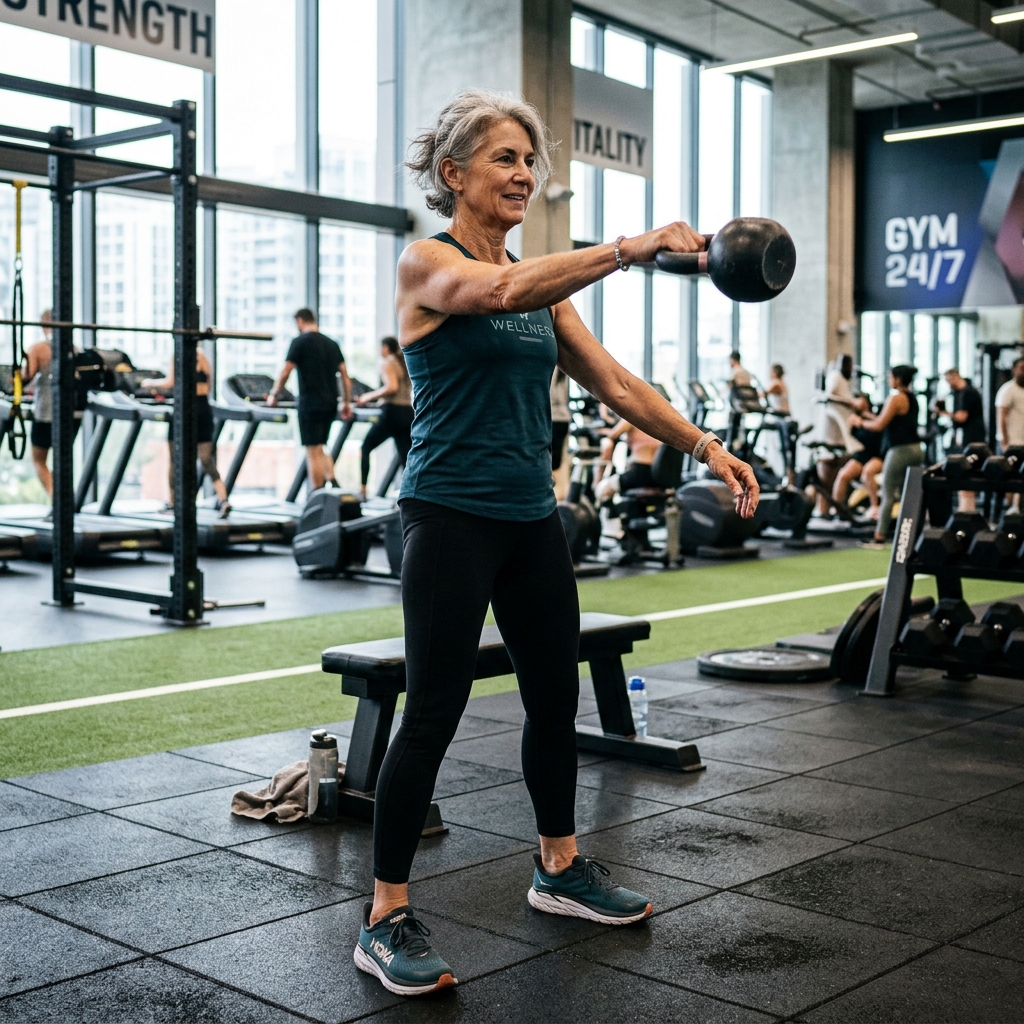
The ability to stand up from a low position is the single best predictor of independent living in older adults. Squats build leg strength, hip mobility and core stability. Start with bodyweight box squats, progress to goblet squats with a kettlebell, then to barbell squats if appropriate.
2. Hinge
The hip hinge (deadlift pattern) builds the posterior chain: glutes, hamstrings and lower back. This is the muscle group that gets up from the floor, picks up grandchildren and stops you falling forward. Romanian deadlifts with dumbbells or kettlebells are the safest starting point.
3. Push
Pushing movements build chest, shoulder and arm strength. Wall push-ups, then incline push-ups, then floor push-ups, then dumbbell presses. Strong pushing muscles mean you can push yourself up if you fall.
4. Pull
Pulling movements build the back and biceps. Most people over 50 have weak backs from decades of sitting. Rows and pull-downs (or assisted pull-ups) reverse the rounded-shoulder posture and protect the spine.
5. Carry
Loaded carries (walking while holding weight) build full-body strength, grip, balance and cardiovascular fitness in one movement. Suitcase carries (weight in one hand) are particularly valuable because they train the anti-lateral-flexion pattern that keeps you upright when you stumble.
A sample weekly strength training plan
For a healthy adult over 50 with no contraindications, a simple and effective weekly structure:
- Monday: Full-body strength session A (squat, push, row, carry), 45 minutes
- Tuesday: Walk 30 to 45 minutes
- Wednesday: Mobility and balance work, 20 minutes
- Thursday: Full-body strength session B (hinge, push, pull, carry), 45 minutes
- Friday: Walk or swim 30 to 45 minutes
- Saturday: Optional third strength session or active recreation
- Sunday: Rest and recover
Common concerns from over-50 clients
Will strength training make my joints worse?
Almost always the opposite. Most joint pain in people over 50 comes from weak muscles around the joint, not from the joint itself. Knee pain is usually weak glutes and quads. Lower back pain is usually a weak core and posterior chain. Strength training, properly programmed, reduces joint pain in the vast majority of cases.
I have arthritis. Can I still train?
In most cases, yes. Controlled, progressive strength training is one of the most effective non-pharmacological interventions for osteoarthritis. The key is to avoid movements that aggravate your joints and to work within a pain-free range of motion. A qualified trainer with experience working with older adults can adapt exercises to your specific needs.
Is it too late to start if I am in my 60s or 70s?
No. Studies have shown strength gains in adults in their 90s. The body responds to resistance at any age. The starting point and rate of progression will be different, but the principles are the same. The best time to start was 20 years ago. The second best time is today.
Coach's note
If you are over 50 and want to start strength training safely in London, the Energise 50+ program is built specifically for you. Each session is scaled to your body, your history and your goals. Book a free taster session to see how it feels.
How long until you see results?
Neurological strength gains (your brain learning to recruit muscle fibres) happen in the first 2 to 4 weeks. You will feel stronger and more coordinated before you look any different. Visible muscle changes typically appear at 8 to 12 weeks. Bone density changes take 6 to 12 months to show on a scan but start happening from week one.
The most important metric for over-50 trainees is not what you look like. It is how you function. Can you get up from the floor without using your hands? Can you carry your shopping up the stairs without stopping? Can you play with your grandchildren without your back giving out? These are the metrics that matter. Strength training improves all of them.
Common questions
How often should a 50-year-old lift weights?
Two to three times per week is optimal for most adults over 50. Each session should last 30 to 45 minutes and cover all major muscle groups. Allow at least 48 hours between strength sessions for recovery.
Is it safe to lift weights over 50?
Yes, when done with proper form and progressive load. Get GP clearance if you have medical conditions. Start light, focus on technique and progress slowly. Strength training is one of the safest and most beneficial activities for adults over 50.
What exercises should a 50-year-old avoid?
There are no universally banned exercises, but some movements need modification based on your individual mobility and history. Heavy behind-the-neck presses, deep barbell back squats with poor mobility and high-impact plyometrics are common ones to approach with caution. A good trainer will modify exercises to fit your body, not the other way around.
Can strength training reverse osteoporosis?
Strength training can significantly slow and in some cases partially reverse bone density loss. Weight-bearing and resistance exercises stimulate bone formation. It is one of the most effective non-pharmacological interventions for osteopenia and osteoporosis, but should be combined with medical guidance.
Train with me in London.
Book a free 45-minute taster session and experience the coaching behind these articles. No commitment, no pressure.
Book your free session